Investigation No. 02 · Chen, Fisher, Gabbay Law Firm
A receiver appointed on the strength of a phone call?
A Mizrahi Tefahot employee testified at the Haifa enforcement office that the affidavit supporting the request to appoint a receiver over a vehicle was signed at his own office, by "telephone signature confirmation". On that same affidavit, attorney Victor Fisher of the Chen Fisher Gabbay firm certified that the deponent "appeared before me" and signed "before me".
Key findings
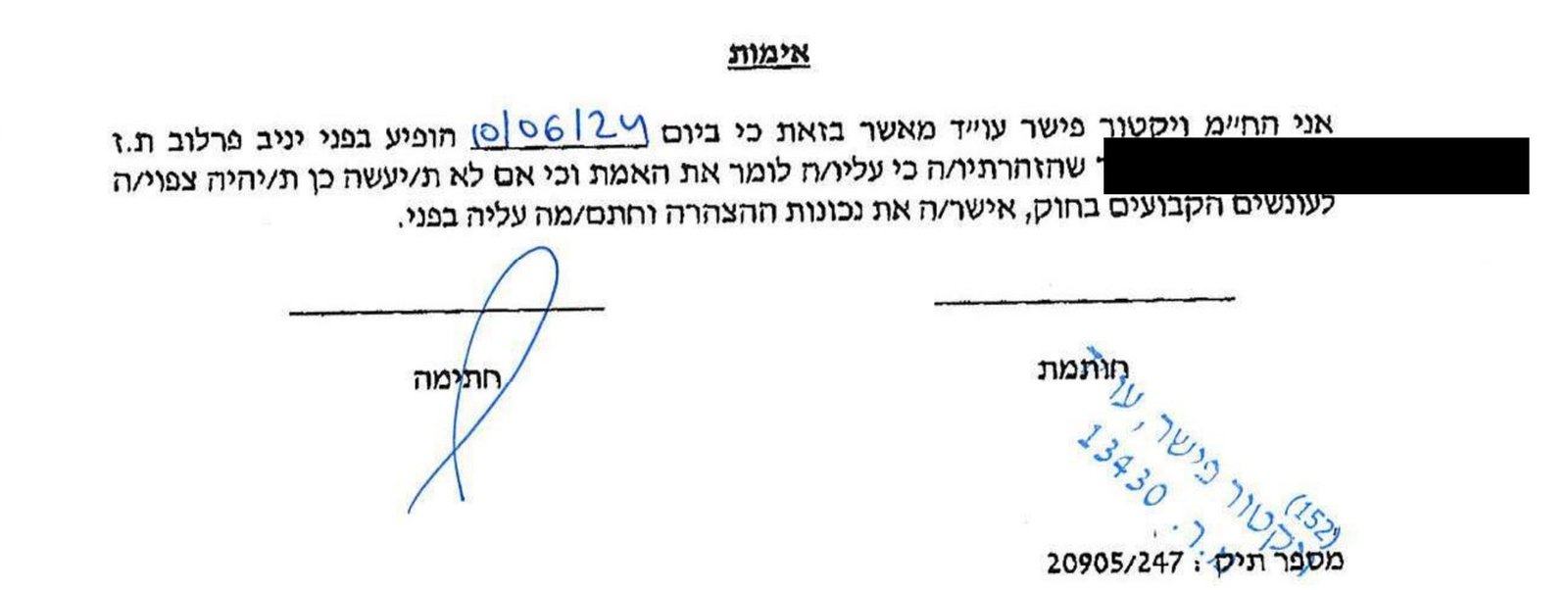
- In an affidavit dated 10 June 2024, filed to support a request to realise a pledge and to appoint attorney Victor Fisher as receiver over a vehicle, the attorney certified in writing that the deponent, Yaniv Perlov, "appeared before me" and "signed it before me".
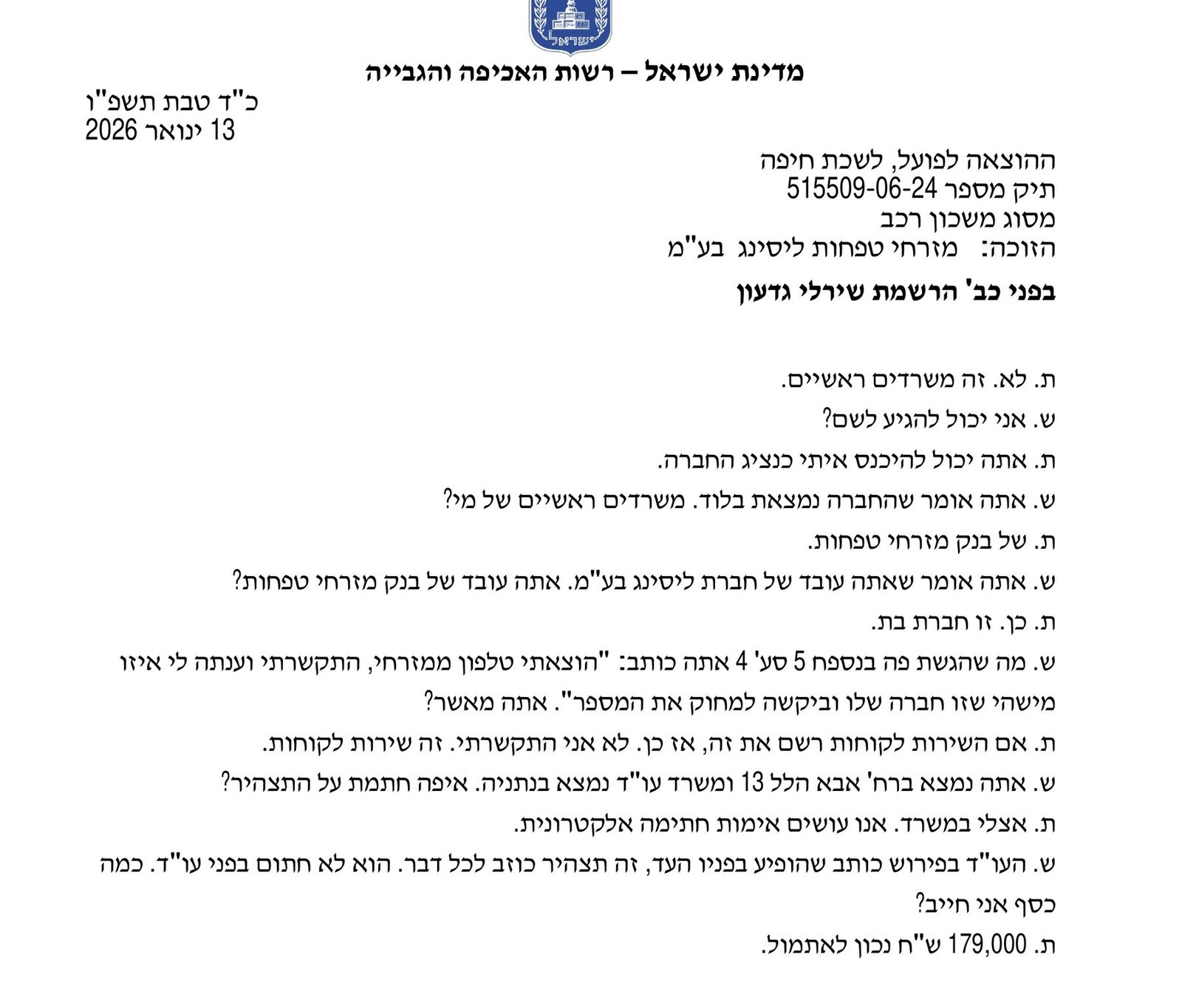
- At the hearing of 13 January 2026 at the Haifa enforcement office the deponent was asked where he had signed the affidavit, answered "at my own office", and, asked whether an attorney had come to him and taken his signature, answered: "We do telephone signature confirmation".
- The verification clause on the affidavit makes no mention of a video conference, of documentation or of a recording, and names no remote means at all.
- The Israel Bar's National Ethics Committee permits remote verification of an affidavit in one way only, a documented video conference, under cumulative conditions that include a dedicated form of wording. Verification over a telephone call is not permitted under it.
- In the same proceeding attorney Victor Fisher held three roles: he acted for the creditor, he verified the affidavit that supported the request, and he was the person appointed, on 1 July 2024, as receiver over the vehicle.
On 13 January 2026 a hearing was held at the enforcement office in Haifa, in file 515509-06-24 for the realisation of a pledge over a vehicle. The creditor in the file is Mizrahi Tefahot Leasing Ltd. The receiver over the vehicle is attorney Victor Fisher, of the Chen Fisher Gabbay law firm in Netanya. In the witness box sat Yaniv Perlov, who had filed an affidavit in the file on behalf of the creditor and was examined on it.
The quotations from the hearing set out below are transcribed from a recording of the hearing held by this article. The questioner is the client himself, a licensed private investigator, who appeared unrepresented and examined the deponent before Registrar Shirly Gideon.
Investigator: You are at 13 Abba Hillel Street in Lod, the attorney is at 4 Arye Regev Street in Netanya. Where did you sign the affidavit?
Yaniv Perlov: I signed at the office.
Investigator: Which office?
Yaniv Perlov: At my own office.
Investigator: Did an attorney come to your office and you signed before him?
Yaniv Perlov: We do telephone signature confirmation.
Investigator: Telephone signature verification…
What the attorney certified on that same affidavit
At the foot of the affidavit, under the heading “Verification”, the following printed wording appears, with the date filled in by hand:
I the undersigned, Victor Fisher, Advocate, hereby certify that on 10/06/24 Yaniv Perlov, ID no. (number omitted), appeared before me, and after I had warned him/her that he/she must tell the truth and that if he/she failed to do so he/she would be liable to the penalties prescribed by law, he/she confirmed the correctness of the statement and signed it before me.
Below the wording: a signature, a stamp reading “Victor Fisher, Advocate” with a licence number, and the firm’s internal file number, 20905/247.
That wording describes a personal appearance. It does not mention a video conference, it does not mention documentation or a recording, and it does not mention any other means.
At the same hearing, after the deponent’s answer:
Investigator: Madam, this is a false affidavit in every respect, it was not signed before an attorney.
The court: All right, so a false affidavit…
The official protocol of the hearing records Perlov’s answer in the form “At my office. We do electronic signature verification.” Telephone or electronic, on both versions the witness describes a verification carried out remotely, from his own office. The attorney’s verification wording describes a personal appearance and names no means at all.
The affidavit on which the appointment rested
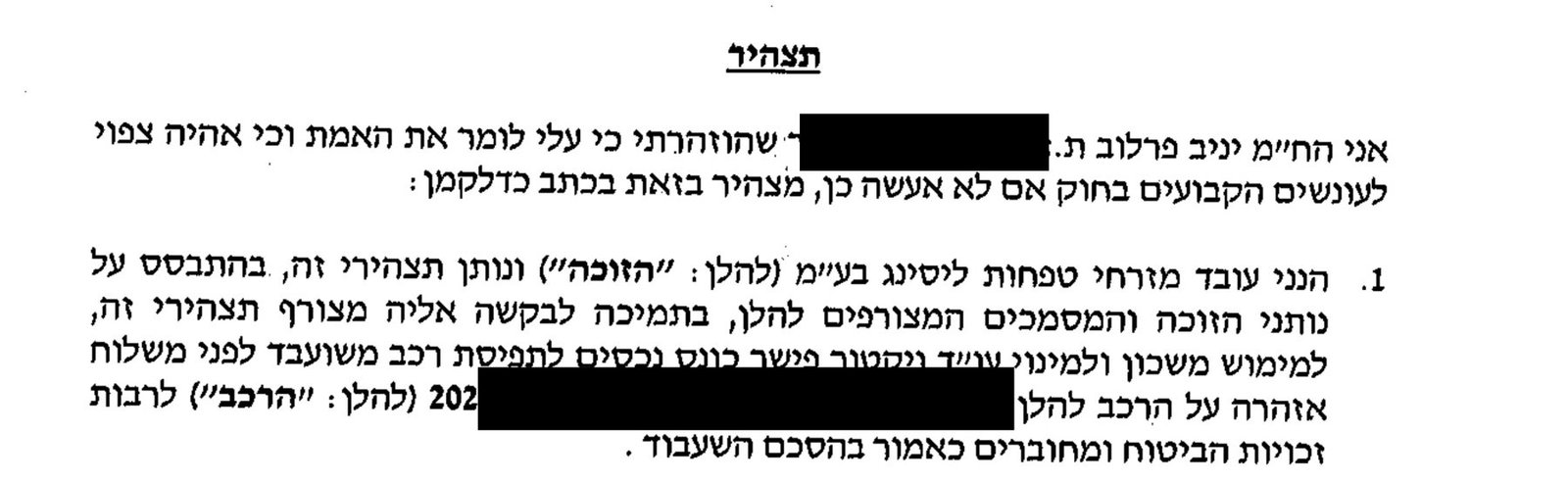
In clause 1 of the affidavit Yaniv Perlov states that he is “an employee of Mizrahi Tefahot Leasing Ltd”, and that the affidavit is given “in support of the request to which this affidavit of mine is attached, for the realisation of a pledge and for the appointment of Adv. Victor Fisher as receiver for the seizure of a pledged vehicle before the sending of a warning notice regarding the vehicle”.
Clause 6 states that the request is made “accordingly and in line with the legal advice I received from the creditor’s counsel”, and asks that a receiver be appointed “ex parte and before service of a warning notice”.
At the same hearing, asked whether he is an employee of Bank Mizrahi Tefahot, Perlov answered: “Yes. It is a subsidiary.” In the affidavit he presented himself as an employee of Mizrahi Tefahot Leasing Ltd.
On 1 July 2024 the creditor’s counsel, attorney Victor Fisher, was appointed receiver over the debtor’s rights in the vehicle. That is stated expressly in the enforcement registrar’s decision of 13 January 2026:
By a decision of 01.07.2024 the creditor’s counsel, Adv. Victor Fisher, was appointed receiver over the debtor’s rights in the vehicle.
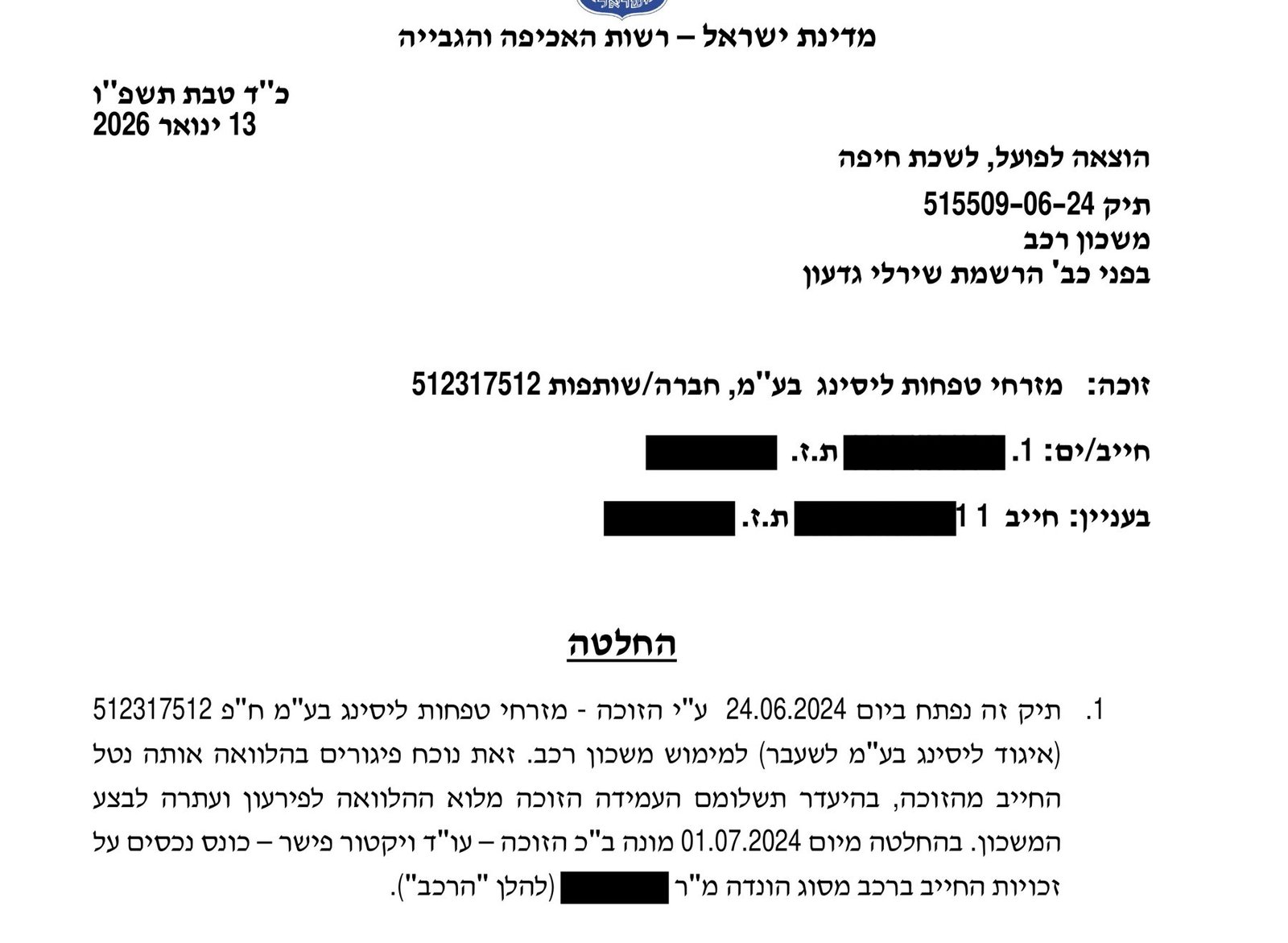
What emerges from these documents is that in the same proceeding attorney Victor Fisher held three roles: he acted for the creditor, and on the wording of the affidavit also stood behind the legal advice on which the request rested; he verified the affidavit that supported the request; and he was the person appointed, in its wake, as receiver over the vehicle.
What the law says
Section 15 of the Evidence Ordinance [New Version], 5731-1971 provides that a written affidavit is admissible evidence “if the deponent was warned that he must state the truth and that he would be liable to the penalties prescribed by law if he did not do so”. The warning, it goes on, shall be given and “the giving of it shall be certified on the face of the affidavit”, by an attorney among others.
This is the heart of the matter. An affidavit does not take its force from the paper it is printed on, but from the warning given to the deponent and from the certificate that the warning was in fact given. That certificate is what turns a printed page into testimony that can be relied on without calling a witness.
Alongside it, section 239 of the Penal Law, 5737-1977 provides that a person who knowingly makes a false affidavit, whether on oath or not, before someone authorised to receive it, is liable to three years’ imprisonment. And under section 17 of the Evidence Ordinance, the court may order the deponent to be examined on his affidavit, and where he does not appear, disqualify the affidavit as evidence.
Not the telephone. Video, under conditions
The Israel Bar’s National Ethics Committee permitted, in decision At/39/20, the remote verification of an affidavit in one way: a video conference, under cumulative conditions.
The attorney and the deponent are both in Israel at the time of verification. The deponent presents an identity document to the attorney on screen. The process of warning and verification is recorded visually and the recording is kept by the attorney. And in the verification wording itself it is written expressly that “the appearance before me was carried out by means of a video conference which is documented in my possession, the deponent appearing before me on screen”. An attorney filing such an affidavit with a court must state that it was made by video conference and that he holds the recording, to be produced if required.
The decision does not permit verification over a telephone call, and it stresses that a video conference is an alternative for cases in which verification in the deponent’s presence was not possible. Earlier still, the Ethics Committee held, in decision At/288/07, that an attorney may not certify a signature on an affidavit even where he watches the deponent sign over a webcam.
The verification wording on the affidavit in this file mentions no video conference, no documentation and no recording. In the same decision the committee stressed that “the attorney’s role in drawing up and verifying the affidavit is not merely technical, since it is the attorney who put into writing the information the deponent gave him, and he must make sure the deponent understood the content of the affidavit as drafted”.
What has been decided in comparable cases
Bar Appeal 19/81 Yishai v. Israel Bar Association, PD 36(3) 192. An attorney certified that the deponent had signed before him, and it was proved that the deponent was not in the country on that date. The Supreme Court upheld the disciplinary conviction and wrote:
The legislature saw fit to empower the body of attorneys to receive affidavits from the public and to verify the deponent’s signature, after warning the deponent of his duty to state the truth. That power was vested mainly in judges, and only because of the trust placed in the body of attorneys did the legislature confer it on them, on the assumption that they would discharge this responsible task faithfully. What the appellant did displays contempt for the duty imposed on him as an attorney and injures the trust placed in the body of attorneys as a whole.
CA 591/70 Mazuz v. Haddad, PD 25(2) 169. The Supreme Court disqualified an affidavit which the deponent had signed in blank, and set out the required order: hand the prepared affidavit to the deponent or read it out to him, explain what he does not understand, and only after the attorney has personally satisfied himself that the deponent understood, warn him as the law requires, have him sign, and then certify with his own signature “that he warned the deponent and that the latter signed before him”.
Disciplinary Case (TA) 13/08 District Committee v. Attorney A. It was held that “in coming to verify an affidavit, the attorney acts as an officer of the court, and as such heightened duties of trustworthiness and care are imposed on him, requiring him to exercise particular strictness in performing his task”.
Alongside these, the material provided for this article also cites decisions of the district disciplinary tribunals on the same subject: Disciplinary Case 143/08 in Haifa, in which an attorney who warned a disabled client by telephone and verified the affidavit as though it had been signed before him was convicted on his own admission, the tribunal rejecting the argument that acting for the client’s benefit was a mitigating circumstance; Disciplinary Case 11/16 in the Northern District, in which an attorney who verified a signature not in the deponent’s presence was convicted of offences under sections 53 and 61(3) of the Bar Association Law; and Disciplinary Case 160/03 in Tel Aviv, in which it was written that “certifying an affidavit unlawfully, as though the deponent had signed before the person receiving it, is a grave offence, and it must be rooted out”. These three decisions are not available in open databases, and their wording could not be verified against a primary source for this article.
In that same decision: the Population Authority record
In the decision of that same day the registrar accepted the client’s contention as to the date of service of the warning notice in the file. He filed a traveller’s record certificate from the Population and Immigration Authority, showing that he was outside Israel continuously between 07.11.2023 and 12.07.2025. The registrar held that on the date recorded as the date of service of the warning notice, 21.04.2025, he was outside the borders of Israel, ordered the cancellation of the service update and corrected it to 02.12.2025. That is the pattern examined at length in the first investigation in this case file, on the reported service in the promissory note file, in a different enforcement office and under the same internal file number at the law firm.
What is attorney Victor Fisher’s position?
That question is for the disciplinary bodies of the Israel Bar and for the courts, not for an article. Under section 63 of the Bar Association Law, 5721-1961, the ethics committee may file a complaint with the disciplinary tribunal, on its own initiative or following a complaint. Disciplinary offences include conduct unbecoming the profession under section 53 and “any other act or omission unbefitting the legal profession” under section 61(3).
What is supported by the documents examined: the verification wording on the affidavit of 10.06.2024, containing the words “appeared before me” and “signed it before me”; the content of clauses 1 and 6 of the affidavit; the recording of the hearing of 13.01.2026, in which the deponent answers that he signed at his own office and that the verification is done by telephone, and the official protocol of that hearing; and the enforcement registrar’s decision of the same day, recording the appointment of attorney Victor Fisher as receiver on 01.07.2024.
What is not proved by the material examined: the manner in which the verification was actually carried out on 10 June 2024; whether a visual record of the verification exists, since if the verification was made by video conference under decision At/39/20 the record should be held by the attorney; what the attorney knew at the time; and whether anyone involved had any particular intent. This article does not find that an affidavit was forged and does not attribute a criminal offence to anyone.
What remains open: the response of the Chen Fisher Gabbay firm and of attorney Victor Fisher. A request for comment is being sent at the same time as this article is published, and any response received will be published here in full.
This article does not attribute to Ofer Chen any personal act in the proceeding described here.
Sources
The affidavit of Yaniv Perlov of 10.06.2024 and the verification wording on it; the recording of the hearing of 13.01.2026 and the protocol of that hearing in file 515509-06-24 at the Haifa enforcement office; the enforcement registrar’s decision of 13.01.2026 in the same file; the Evidence Ordinance [New Version], sections 15 and 17; the Penal Law, section 239; the Bar Association Law, sections 53, 61 and 63; National Ethics Committee decision At/39/20; Ethics Committee decision At/288/07; Bar Appeal 19/81 Yishai, PD 36(3) 192; CA 591/70 Mazuz v. Haddad, PD 25(2) 169; Disciplinary Case (TA) 13/08; Disciplinary Cases 143/08, 11/16 and 160/03. A review of an attorney’s duties in relation to affidavits, by Dr Limor Zer-Gutman, published by the College of Management Academic Studies.
The Hebrew version of this article is the authoritative text.
This section is documented factual reporting, not legal advice. Every statement is based on the cited material; the parties concerned may respond at any time and their response will be published.
AI tools were used in preparing this article to process the source material, to black out identifying details and to translate. The reporting, the findings and the responsibility for them are the author's. This version was translated from the Hebrew original with the help of AI tools and checked before publication. In case of any discrepancy, the Hebrew version prevails.
Legal basis
- Section 15 of the Evidence Ordinance [New Version], 5731-1971A written affidavit is admissible evidence only if the deponent was warned that he must tell the truth and would be liable to the penalties prescribed by law if he did not; the giving of that warning is certified on the face of the affidavit, by an attorney among others
- Section 17 of the Evidence OrdinanceThe court may order the deponent to be examined on his affidavit; if he does not appear, the affidavit may be disqualified as evidence
- Section 239 of the Penal Law, 5737-1977A person who knowingly makes a false affidavit before someone authorised to receive it is liable to three years' imprisonment
- National Ethics Committee decision At/39/20Verification of an affidavit by video conference is permitted only under cumulative conditions: both parties in Israel, an identity document shown on screen, a visual recording of the warning and the verification, and a form of wording stating expressly that the appearance was made by video conference documented in the attorney's possession
- Ethics Committee decision At/288/07An attorney may not certify a signature on an affidavit even where he watches the deponent sign over a webcam
- Bar Appeal 19/81 Yishai v. Israel Bar Association, PD 36(3) 192A disciplinary conviction was upheld where an attorney certified that the deponent had signed before him, and it was proved that the deponent was not in the country on that date
- CA 591/70 Mazuz v. Haddad, PD 25(2) 169Only after the attorney has personally satisfied himself that the deponent understood the text may he warn him as the law requires, have him sign, and then certify that he warned him and that the deponent signed before him
- Disciplinary Case (TA) 13/08 District Committee v. Attorney A.In verifying an affidavit the attorney acts as an officer of the court, and heightened duties of trustworthiness and care apply to him
- Sections 53, 61(3) and 63 of the Bar Association Law, 5721-1961Conduct unbecoming the profession; any other act or omission unbefitting the legal profession; and the Ethics Committee's power to file a complaint with the disciplinary tribunal
Questions and answers
What is a receiver in Israeli enforcement proceedings?
An officeholder appointed by the enforcement registrar to seize a pledged asset, hold it and realise it towards payment of the debt. In a file for the realisation of a pledge over a vehicle, the receiver is the person authorised to locate the vehicle, seize it and sell it. The appointment may be granted ex parte, that is without the other side being heard, and sometimes before a warning notice has even been served. That is why the request for the appointment must be supported by an affidavit verifying the facts.
Can an affidavit be verified over the telephone in Israel?
No. Section 15 of the Evidence Ordinance requires that the deponent be warned and that the giving of the warning be certified on the face of the affidavit, and the practice is signature in the presence of the person receiving it. The Israel Bar's National Ethics Committee permitted one alternative to physical presence, a video conference, and only under cumulative conditions: both parties in Israel, an identity document shown on screen, a recording of the process, and wording stating expressly that the appearance was made by video conference documented in the attorney's possession. A telephone call does not meet those conditions.
What happens when it turns out an affidavit was not signed in the attorney's presence?
Two separate levels. On the evidentiary level, the court or the registrar may weigh the affidavit and may disqualify it, and where a decision rested on it, its setting aside can be sought. On the disciplinary level, a false certificate of signature verification has repeatedly come before the Bar's disciplinary tribunals, and before the Supreme Court in the Yishai case, where it was held that the power to verify affidavits was given to attorneys only because of the trust placed in them.
Can the same attorney act for the creditor and also be appointed receiver in the same file?
In Israeli enforcement practice the appointment of the creditor's counsel as receiver is common, and it is made by a registrar's decision. The question that arises from the documents here is not the appointment as such, but the combination of roles: the same attorney acted for the party seeking the appointment, verified the affidavit that supported the request, and was then appointed receiver himself. What that combination means is for the Bar's disciplinary bodies and the courts to decide, not for an article.
How is a complaint against an attorney filed in Israel?
A complaint is filed with the ethics committee of the district committee where the attorney is registered, or with the National Ethics Committee. Under section 63 of the Bar Association Law, the ethics committee may file a complaint with the district disciplinary tribunal, on its own initiative or following a complaint. Disciplinary offences include conduct unbecoming the profession under section 53 and any act or omission unbefitting the profession under section 61(3).