Investigation No. 01 · Chen, Fisher, Gabbay Law Firm
"So that there will be no unknown services in my file"
Seven weeks before the file was opened, the client told the law firm that he was abroad and that the Israeli address was no longer his. Months later a personal service of the warning notice was reported at that address, and nine days after it was keyed in, 21,456.50 shekels in fees were added to the debt.
Key findings
- Seven weeks before the pledge realisation file was opened, the law firm's representative was told in writing that the client was abroad and that the Israeli address was no longer his.
- A tracing report by the service company states that its agent met the client at the address on 22 December 2024. According to the traveller details certificate, he was not in Israel that day.
- The date of service was keyed into the enforcement system manually on 20 January 2025, almost a month after the date recorded as the date of service. The deadline for filing an objection fell on the day after the entry.
- Nine days after that manual entry, stage B fees of 21,456.50 shekels were added to the debt. The service itself had cost 81.90 shekels.
- On 21 October 2025 the Enforcement Registrar held that on the reported date of service the client was outside Israel, and ordered the proceedings and the added fees cancelled.
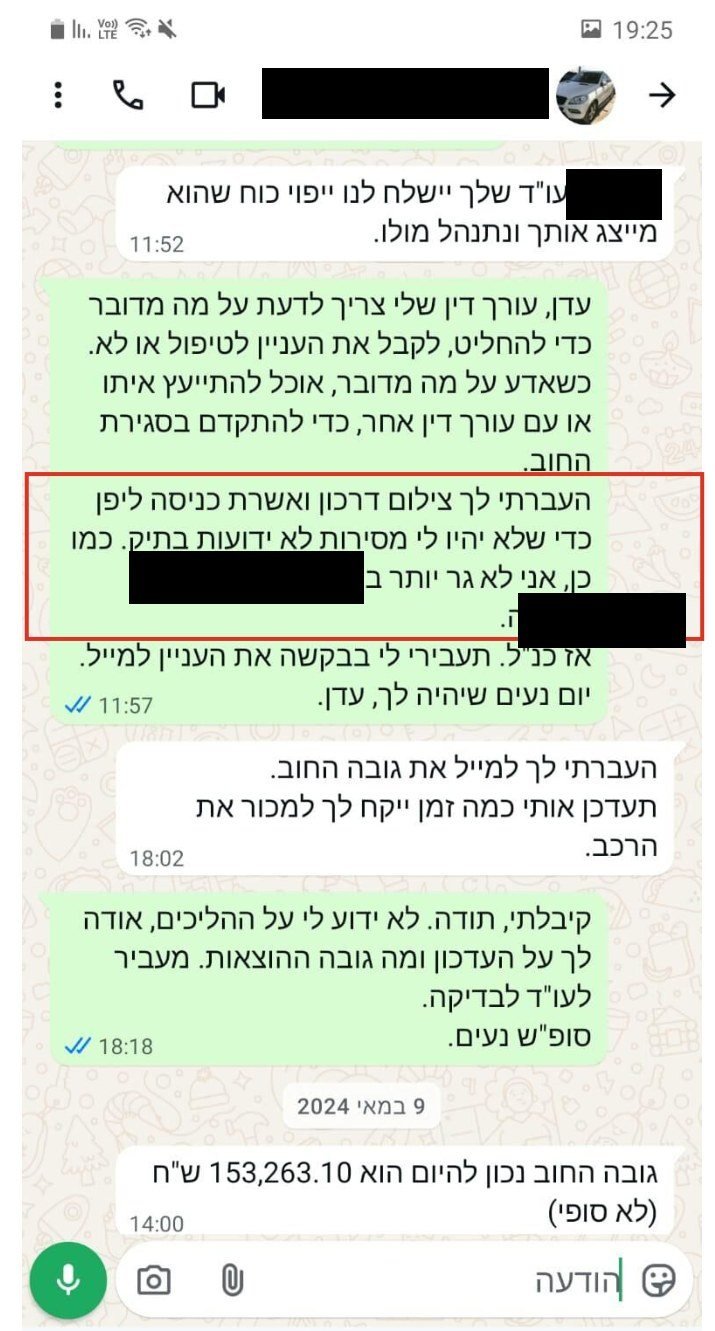
Seven weeks before the pledge realisation file was opened, a representative of the Chen, Fisher, Gabbay law firm received a message from the client: he was abroad, the address registered in Israel was no longer his, and he asked that a copy of his passport and his Japanese entry visa be added to the file, “so that there will be no unknown services in my file”.
Months later a personal service of the warning notice was reported at that same address. The process server’s affidavit states that the client received the documents and refused to sign “for personal reasons”. Yet according to a traveller details certificate issued by the Population and Immigration Authority, he was not in Israel at all that day.
On 20 January 2025 the date of service was keyed into the enforcement system manually. Nine days later, stage B fees of 21,456.50 shekels were added to the debt in the file. The Enforcement Registrar later held that on the reported date of service the client was outside Israel, and ordered the proceedings and the added fees cancelled.
The Chen, Fisher, Gabbay firm, also known as Chen Fisher, presents Victor Fisher and Ofer Chen on its website as founding partners, and collection, enforcement and the realisation of security interests as part of its practice. In the documents examined for this article Victor Fisher appears on the certification of an affidavit, discussed below. The material provided for this article does not attribute any personal act to Ofer Chen in the files described here.
Part one: what happened
1. The loan and the attempt to repay it
In December 2021 the client took a loan of 184,000 shekels to buy a Honda, on a balloon repayment track, from Igud Leasing Ltd. He added about 58,000 shekels of his own.
At the start of 2023 the counterparty changed. Bank Igud was merged into Mizrahi Tefahot, and Igud Leasing became Mizrahi Tefahot Leasing Ltd. The telephone lines listed in the contract were disconnected and the Bank Igud website went offline. The material provided for this article contains no notice sent to the client about the change in contact details, although clause 24 of the contract deals with written notice of a change of particulars and clause 28 directs enquiries to Bank Igud.
After the war broke out the client asked for a deferral of payments under the Bank of Israel framework. The answer he received was unusual:
“Mizrahi Tefahot has no loan registered in his name at all.”
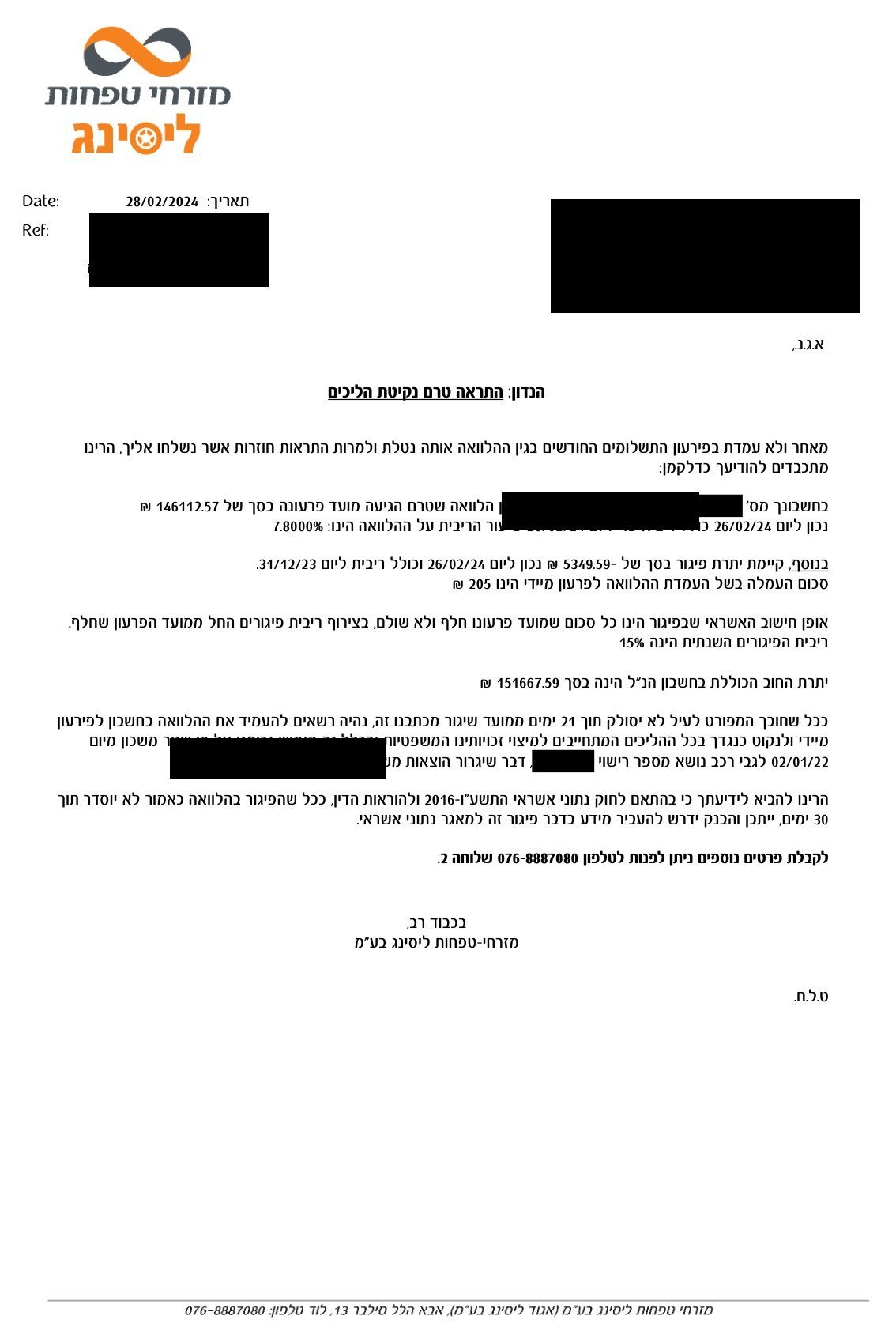
From the client’s point of view this left a gap that is hard to reconcile. There was a contract, there was a pledged vehicle and there was a standing order, but the bank he approached told him it had no loan registered in his name. On a balloon loan at a variable rate the interest meanwhile went on accruing, and according to the documents it came to more than a thousand shekels a month.
In November 2023 the client left Israel. On 25 December an entry was made in the bank’s log regarding the account from which the loan was repaid:
“The account was finally closed by a bot.”
On 28 February 2024 a “warning before proceedings are taken” was issued. The arrears it recorded were two instalments, 5,349.59 shekels in all. The letter was addressed to “16 / ****”, a house number and a locality, with no street name, and the material provided for this article does not show how or where the warning was sent.
2. “Hi Eden. I am abroad”
On 17 April 2024 the client sent an email to Mizrahi Tefahot:
“I am not in the country… I want to pay off the loan and sell the car myself. Could you please help me find out the final payoff figure?”
On 2 May a WhatsApp message reached him from a representative of the law firm:
“Hello, this is Eden from the offices of Chen Fisher, advocates.”
His reply was immediate:
“Hi Eden. I am abroad.”
Later in the same exchange he wrote:
“I want to close the debt and sell the car.”
And in a further message:
“I sent you a copy of my passport and my Japanese entry visa so that there will be no unknown services in my file.”
He then made it explicit:
“I no longer live at * street, in **** .”
And finally asked:
“Please add this to the file.”
The documents therefore show that by early May 2024 the representative of the Chen, Fisher, Gabbay firm had been told that the client was abroad and that the address in Israel was no longer his. The material held by this article does not show who inside the firm was later exposed to that information, or who handled each stage of the proceedings.
3. The affidavit
Seven weeks after that exchange, on 24 June 2024, a file for realisation of the pledge on the vehicle was opened in Haifa.
Attached to the application was an affidavit by Yaniv Perlov dated 10 June 2024. It opens with the words:
“I am an employee of Mizrahi Tefahot Leasing Ltd”,
which the affidavit defines as the “creditor”.
Questioned in January 2026 about where he worked, Perlov answered:
“I am an employee of the bank.”
This is a contradiction between the affidavit and the answer given under questioning, and it calls for an explanation. The material provided for this article does not make it possible to determine whether this reflects parallel employment, a secondment, some other organisational definition, or a mistaken entry in the affidavit.
The application supported by the affidavit asked for the appointment of a receiver and for the vehicle to be seized before the warning notice was sent, out of a concern that the debtor would make it disappear once he learned of the proceedings.
Beneath the heading “Certification” the affidavit reads:
“I the undersigned, Victor Fisher, advocate, hereby certify that on 10/06/24 Yaniv Perlov appeared before me… confirmed the truth of the statement and signed it before me.”
Under questioning Perlov was asked whether he had travelled to Victor Fisher’s office in Netanya to sign. His answer was:
“At my own office. We do electronic signature certification.”
The answer raises a question about how the certification was in fact carried out, but does not in itself prove that it was defective.
Section 15 of the Evidence Ordinance allows a written statement to be received as an affidavit where the deponent has been duly cautioned and the caution is certified on the face of the affidavit. A decision of the National Ethics Committee dealing with certification of an affidavit by video conference set out detailed conditions for such a process, among them identifying the deponent, cautioning him, recording the process and retaining the record. The wording prescribed in that decision also uses the words “appeared before me”, even though the appearance is by video.
The use of the words “appeared before me” therefore does not prove that the deponent was physically present at the lawyer’s office.
The question that remains open is a different one: what certification process was in fact carried out on 10 June 2024, on which track, and whether the required conditions were met. The material provided for this article does not fully answer it.
From this point on it matters to distinguish between two enforcement files arising from the same loan: the pledge realisation file and the promissory note file. The services, the opening amounts and the fees are not the same in the two.
4. “Refused to sign for personal reasons”
On 15 December 2024 a warning notice was issued in the promissory note file.
The service confirmation form carried the addressee’s address in print:
“16, postcode 6094400”.
No street name was printed on the form. It was added by hand.
Twelve days before the date of service that was later reported, on 10 December, the Chen, Fisher, Gabbay firm sent the client a WhatsApp message. He replied the same day that he was abroad.
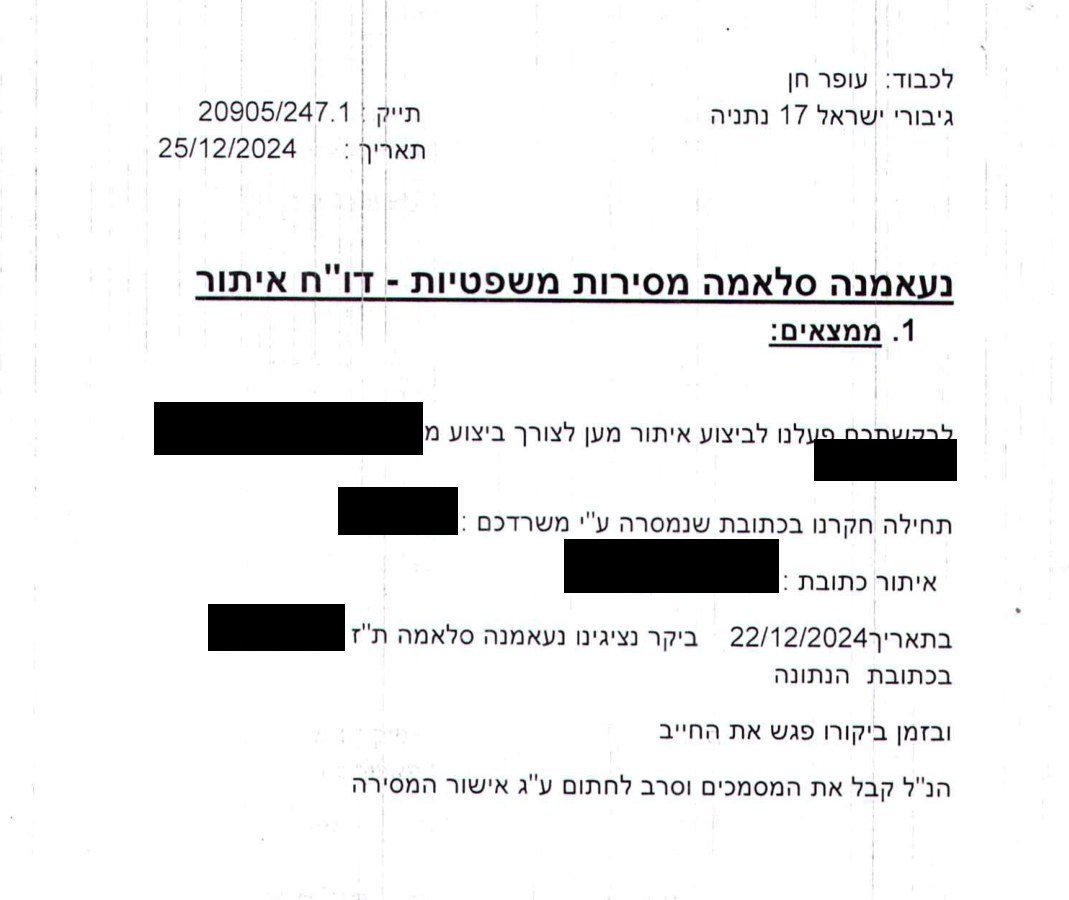
On 25 December 2024 a tracing report reached the firm from Naamneh Salameh Legal Services, under internal file number 20905/247.1. The report states:
“On 22/12/2024 our agent visited… and during his visit met the debtor. The above received the documents and refused to sign.”
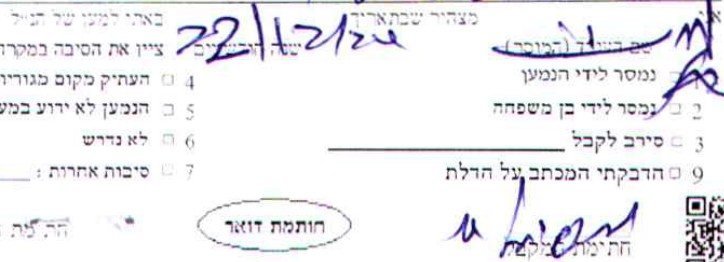
In the process server’s affidavit the box “served but refused to sign” was marked. In the field where the server was asked to state who refused, the handwritten words are:
“Refused to sign for personal reasons.”
The invoice attached to the service came to 70 shekels before VAT, 81.90 shekels after.
But on 22 December 2024 the client was not in Israel.
According to the traveller details certificate issued by the Population and Immigration Authority, he left Israel on 7 November 2023 and returned only on 12 July 2025. The record shows an unbroken period with no intervening entry.
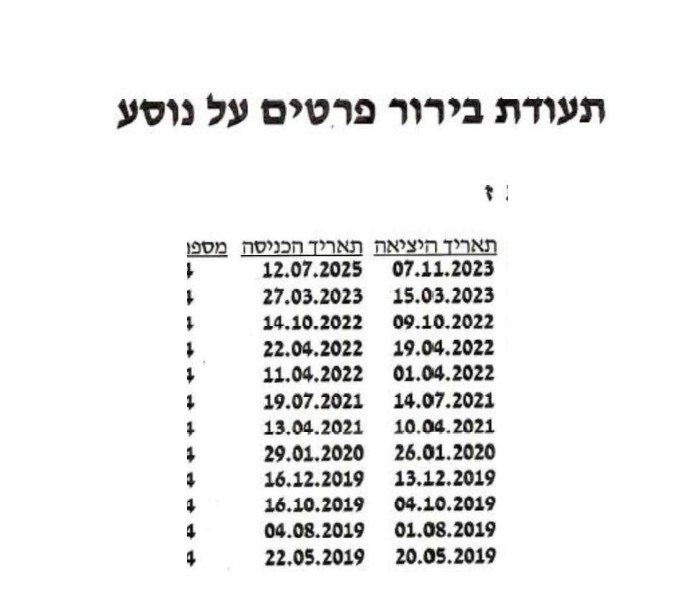
The description of a meeting with the client in Israel on 22 December 2024 therefore cannot be reconciled with the record of entries and exits.
Even so, these documents on their own do not prove what actually happened at the service company. They do not show whether the server reached the address and met a different person, whether he met nobody at all, or how the report stating that he met the debtor came to be written. What they do show is that the person identified in the report as the “debtor” was not in Israel on the date on which he was reported to have been met.
On 21 April 2025 a further report was recorded from the same server and to the same firm, worded similarly. On that date too the client was not in Israel. He had by then been out of the country for 531 days.
5. Nine days, 21,456.50 shekels
On 20 January 2025 the Chen, Fisher, Gabbay firm reported to the enforcement system:
“Warning notice of 15/12/2024 updated to refused to sign, date of service: 22/12/2024, by manual update. Last date for objection changed to 21/01/2025.”
The practical meaning of the entry was unusual: the date of service recorded in the system was 22 December, but the update was in fact carried out only on 20 January. The last date for objection recorded in the system fell on the day after the update.
The Execution Law provides that in a promissory note file the period for filing an objection is thirty days from service of the warning notice. Here, the thirty days ran from a date of service that had been entered retroactively.
On 29 January 2025, nine days after the manual update, the file recorded:
“Increase of the lawyer’s fee principal… in the sum of NIS 21,456.50… reason for the increase: increase of the debt on account of stage B fees.”
On the same day 31 procedural vouchers were also issued in the file.
The fact that the update was carried out manually does not in itself show why it was done that way or who decided on its content. Its significance here is chronological: service of the warning notice is the fact on which the counting of time rests, and the date of service was entered almost a month after the date recorded as the date of service.
6. What happened after the Registrar cancelled the service
After returning to Israel and discovering the file, on 29 September 2025 the client filed an objection and attached the record of entries and exits.
On 21 October 2025 the Enforcement Registrar held that on the reported date of service the client was outside Israel, and ordered:
“the cancellation of all steps carried out in the file, and the cancellation of the stage B fees added to the debt in the file.”
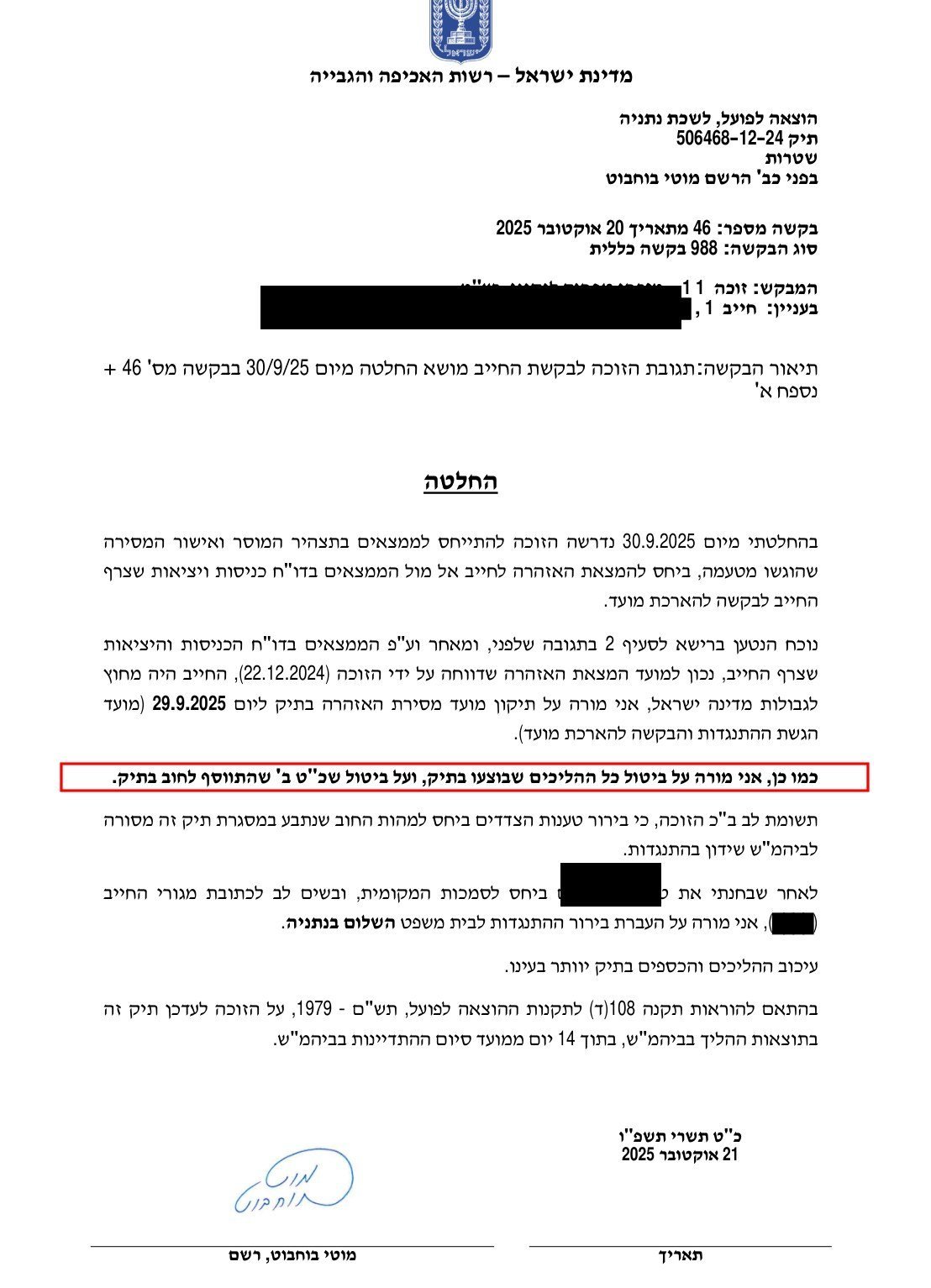
Five restrictions were cancelled that day, among them restrictions relating to a passport and to leaving the country.
The fees of 21,456.50 shekels were deleted from the file.
In August 2026 the receiver in the other file was required to submit an updated statement of the outstanding debt. The client contends, on the basis of a comparison between the ledgers he attached to his application, that the same item of 21,456.50 shekels appeared again in the ledger submitted in the pledge file.
That contention has not been determined as a judicial finding in the material provided for this article, and it is therefore presented here as the client’s contention based on a comparison of documents, not as a ruling of the Enforcement Registrar.
Part two: what the contract, the law and the arithmetic say
7. What the contract says
The engagement agreement governs two central points in this story.
The right to repay. Clause 3.1 provides:
“The borrower may make early repayment on his own initiative provided that he notifies the company in writing at least 10 business days before the date on which he wishes to make the early repayment, and states the amounts he wishes to repay.”
The contract itself, in other words, gives the borrower the option of early repayment, subject to written notice within a set time.
In April and May 2024 the client gave written notice that he wished to pay off the loan and sell the car.
The duty to warn. The same clause also provides that:
“The company shall not call in the loan, or any part of it, for early repayment on its own initiative without having given the borrower written warning in accordance with the provisions of law.”
There is also a further figure that calls for explanation.
Under clause 5.1.2 of the contract, the promissory note was intended to secure the balance of the loan, recorded there as 143,978 shekels.
The promissory note itself carries a figure of 184,000 shekels, the original loan amount.
The application for execution states a figure of 159,609.83 shekels, on the basis of a one page internal document attached to the application and bearing no signature.
There are therefore three different figures in the material: 143,978 shekels in the contract, 184,000 shekels on the note and 159,609.83 shekels in the application for execution.
The mere existence of three figures does not prove which of them is wrong. It does call for an explanation of how the outstanding debt was calculated and what the basis was for the amount included in each document.
This matters, among other reasons, because the amount stated in the application for execution bears directly on the fees added to the file.
8. What the law says
The warning before immediate repayment.
Section 7 of the fair credit provisions lays down that where a lender seeks to bring forward the repayment date of the balance of a loan, it must send the borrower a warning and allow a period of not less than 21 business days in which to act to prevent the loan being called in.
The law provides an exception where special circumstances exist in which there is a real concern that giving the warning would harm the ability to collect.
The warning of 28 February 2024 specified 21 days, not 21 business days. Nor does the material provided for this article contain any confirmation from which it can be learned how and when the warning was served on the client.
The warning notice in enforcement proceedings.
Section 7 of the Execution Law provides as a rule that execution does not begin before a warning notice has been served and before the period stated in it has passed, unless the Enforcement Registrar considers that the circumstances of the matter justify taking a step earlier.
Where a step before the warning notice is sought, Regulation 14 of the Execution Regulations requires a reasoned application supported by an affidavit verifying the facts contained in it.
That is the legal setting in which the Perlov affidavit was filed in the pledge realisation file: it was intended to support the facts on the basis of which a step was sought even before the warning notice was served.
And what happens when the debtor refuses to sign?
Section 7(d) of the Execution Law provides:
“Where the debtor, or a person on whom the warning notice may be served by full service, refuses to accept the warning notice or to sign a service confirmation, the debtor shall be regarded as one on whom the warning notice has been served by full service; the note of the postal clerk or of the server recording the refusal shall be evidence of its truth.”
The server’s note recording a refusal to sign therefore carries real legal weight. It may result in the warning notice being treated as fully served.
Full service, in turn, is a condition for taking some of the steps and imposing some of the restrictions that the law permits.
In this case the Enforcement Registrar, after being shown the Population Authority record, held that on the reported date of service the client was outside Israel, and went on to cancel the proceedings and the fees added in consequence of them.
As to the affidavit and its certification.
Section 15 of the Evidence Ordinance sets out the conditions under which a written statement acquires the status of an affidavit admissible in evidence, among them cautioning the deponent that he must tell the truth, and certification of the caution on the face of the affidavit by a person authorised to do so.
The decision of the National Ethics Committee on certification by video conference established a detailed mechanism for remote certification.
The relevant contradiction is therefore not between the words “appeared before me” and the fact that the deponent was sitting in another office. Visual certification may count as an appearance before the lawyer.
The question the material has not yet answered is what certification process was in fact carried out and whether the relevant conditions were met.
This article does not determine that the certification of the Perlov affidavit was defective.
9. Where the money came from
Section 10 of the Execution Law provides that a creditor represented by a lawyer is entitled, subject to the Registrar’s power to rule otherwise, to lawyer’s fees in accordance with the schedule set under the Bar Association Law.
Here the figures matter.
The pledge file.
Under the schedule in force in 2024, on realisation of a pledge in an amount falling within the first bracket, the fee for filing the application is 5 per cent of the amount included in the application for execution.
The Perlov affidavit states:
“In light of the value of the vehicle according to the Levi Yitzhak price list, and for fee purposes only, the file will be opened in the sum of NIS 118,000.”
The calculation is: 118,000 × 5% = 5,900 shekels. With VAT at the 17 per cent rate in force in 2024: 6,903 shekels. That is the amount recorded in the statement of account.
The promissory note file.
In a promissory note file, the fee for filing the note for execution is calculated as a fee in a monetary claim.
Under the official schedule for 2024, on an amount exceeding 119,301 shekels the calculation is 10 per cent of the first 119,301 shekels plus 4 per cent of the remainder.
The statement of account records stage A fees of 15,871.72 shekels.
Precision is needed here.
A calculation on 159,609.83 shekels alone does not reach that figure. It yields about 15,844.67 shekels including VAT at 17 per cent.
The amount recorded in the file, 15,871.72 shekels, is very close to a calculation in which the opening interest recorded in the statement of account, 576.56 shekels, is added to the 159,609.83. Even then a gap of a few agorot remains.
On the material available it is therefore possible to say what fee was recorded, but not to determine exactly which numerical basis the system used to calculate it.
Alongside the fees, a court fee of 2,002 shekels, opening interest of 576.56 shekels and expenses of 15.10 shekels were recorded. The total amount of the warning notice was 178,075.21 shekels.
The point that matters is not who “chose” any particular figure, but that the amount included in the application for execution, and the balance recorded in the file, both bear on the calculation of the fees.
The pledge file records an opening amount of 118,000 shekels. The promissory note file records a principal of 159,609.83 shekels. The original promissory note carries 184,000 shekels. The contract states 143,978 shekels as the balance of the loan that the note was to secure.
These gaps call for an accounting and legal explanation in their own right.
And then came the stage B fees.
Under the schedule, in a promissory note file where the adjudicated debt falls within the relevant bracket, the fee for conducting the file is 10 per cent of the adjudicated debt, provided that the conditions set in the schedule are met.
The balance of the file immediately before the charge, according to the statement of account, was 181,834.76 shekels. Ten per cent is 18,183.48 shekels. From 1 January 2025 the VAT rate rose to 18 per cent. With VAT: 21,456.50 shekels.
That calculation matches the amount recorded in the file to the agora.
There are two further points here.
The first concerns the definition of “adjudicated debt”. Under the schedule, the debt on which stage B fees are calculated also includes the fees added when the file was opened.
Here the balance of the debt included stage A fees of 15,871.72 shekels. Ten per cent of that, plus 18 per cent VAT, is 1,872.86 shekels.
In other words, 1,872.86 shekels of the stage B fees derived from the fee component already recorded when the file was opened.
The second point is the conditions for adding stage B fees.
The schedule provides that the debtor did not pay the sum demanded within the period set in the warning notice, and that the lawyer took further steps after the notice was served and the period stated in it had ended.
Service of the warning notice, and the date on which it is treated as served, therefore bear directly on entitlement to add the fees.
Here the service was reported as having taken place on 22 December 2024. It was keyed into the system manually on 20 January 2025. Nine days after that entry, the stage B fees were added to the file.
The accounting summary
| What was charged | Amount | Basis of the entry |
|---|---|---|
| Stage A fees, pledge file | 6,903.00 shekels | 5% of 118,000 shekels, plus VAT |
| Stage A fees, promissory note file | 15,871.72 shekels | the amount recorded in the statement of account; the exact basis of calculation is not set out in the material |
| Stage B fees, promissory note file | 21,456.50 shekels | 10% of a file balance of 181,834.76 shekels, plus VAT |
| Total fees to 29 January 2025 | 44,231.22 shekels | |
| Cost of the service on which the update of the warning notice rested | 81.90 shekels | invoice of the service company |
By way of comparison, had the client’s request of April 2024 to pay off the loan been met and the loan repaid before an enforcement file was opened, the enforcement fees described here would never have arisen.
The hypothetical comparison with a single file route also calls for caution. Calculating the opening fee of a promissory note file in 2024 on an amount of 143,978 shekels, under the official schedule and with VAT at 17 per cent, gives about 15,112 shekels.
Stage B fees would not have been added had the debt been paid within the period set in the warning notice and had the conditions for adding them not been met.
In terms of the fees recorded in the two files up to 29 January 2025, the figure is 44,231.22 shekels.
10. What is proved, what is alleged and what is still open
Supported by the documents examined: the WhatsApp exchange of May 2024 with the representative of the Chen, Fisher, Gabbay firm; the email of April 2024; the dates of departure and return according to the Population Authority certificate; the bank’s log entries; the warning of February 2024; the Perlov affidavit and the certification wording on it; the opening of the pledge realisation file and the promissory note file; the tracing reports and the process server’s affidavit; the service company’s invoice; the manual update of the date of service of the warning notice; the statements of account; the decisions of the Enforcement Registrar; and the transcript of the questioning of January 2026.
Contentions not yet determined as findings: the contention that an economic investigation from early 2024 already noted that the client was not in Israel. A reply of February 2026 did not deny that the document exists, but its contents were not shown to this article. The same applies to the contention that the cancelled fees later appeared in the ledger submitted in the pledge file. The client says the contention is supported by a comparison of documents, but no judicial decision establishing it as a finding was produced.
Not proved in the material examined: who created the incorrect report of service; whether whoever created or keyed it in knew that the client was abroad; whether information given to the representative of the Chen, Fisher, Gabbay firm in May 2024 reached the person who handled the service in December; whether anyone instructed that a false report be given; whether anyone read the economic investigation report; and what caused the account to be closed in December 2023.
Nor is there any basis in the material for attributing a personal act in the file to Ofer Chen merely because he is a founding partner of the firm.
Still open: the original amortisation schedule, which would allow the gap between the contractual payments and the actual charges to be examined; the source of the “price list difference” item of 33,026.86 shekels; the exact basis of calculation that produced stage A fees of 15,871.72 shekels in the promissory note file; the contents of further documents that were requested and not provided; and how the Perlov affidavit was in fact certified on 10 June 2024.
Finally, two enforcement files are being conducted on the same 2021 loan, in two different offices, under the same internal file number at the law firm.
This section is documented factual reporting, not legal advice. Every statement is based on the cited material; the parties concerned may respond at any time and their response will be published.
AI tools were used in preparing this article to process the source material, to black out identifying details and to translate. The reporting, the findings and the responsibility for them are the author's. This version was translated from the Hebrew original with the help of AI tools and checked before publication. In case of any discrepancy, the Hebrew version prevails.
Legal basis
- Section 7, Execution Law, 1967Execution does not begin before a warning notice has been served and the period stated in it has passed, unless the Registrar considers that the circumstances justify an earlier step
- Section 7(d), Execution LawWhere the debtor refuses to accept the warning notice or to sign the service confirmation, the notice is deemed fully served; the server's note recording the refusal is evidence of its truth
- Regulation 14, Execution Regulations, 1979A request for a step before the warning notice must be reasoned and supported by an affidavit verifying the facts in it
- Section 7, Fair Credit provisions, Supervision of Financial Services LawCalling in the balance of a loan requires a warning and a period of not less than 21 business days, save in special circumstances
- Section 15, Evidence Ordinance [New Version], 1971The conditions under which a written statement becomes an affidavit admissible in evidence: the deponent is cautioned, and the caution is certified on the face of the affidavit
- Section 10, Execution Law, and the Bar Association fee scheduleThe basis for stage A and stage B fees in a promissory note file and in a pledge realisation file
- Decision of the National Ethics Committee on certifying an affidavit by video conferenceIdentification of the deponent, the caution, recording of the process and its retention. The wording it prescribes also uses the words "appeared before me"
Questions and answers
What is false service of process?
A report of service of a legal document that did not take place as reported. In enforcement proceedings this has a practical consequence: the date of service is the point from which the period for filing an objection runs, and it is also the condition for taking further steps and for adding fees. If the service did not happen, everything built on it rests on a wrong footing.
The server recorded that the addressee refused to sign. What does that mean legally?
Section 7(d) of the Execution Law provides that refusing to accept the warning notice or to sign the service confirmation counts as full service, and that the server's note recording the refusal is evidence of its truth. A note saying "refused to sign" therefore carries real weight, and may be enough for proceedings to begin.
What do you do when you discover an enforcement file you were never told about?
In a promissory note file the period for filing an objection is thirty days from service of the warning notice. Once it has passed, an application to extend time can be filed together with the objection. In the case described here the entry and exit record from the Population and Immigration Authority was attached, and the Registrar held on that basis that on the reported date of service the client was outside Israel.
How do you prove you were not in the country on the reported date?
A traveller details certificate from the Population and Immigration Authority shows the dates of exit and entry. An unbroken period with no intervening entry contradicts a report of a personal meeting in Israel on that date.
What are stage B fees and when may they be added?
Fees for conducting the file, at a rate set in the schedule as a share of the adjudicated debt. Under the schedule they depend on the debtor not having paid within the period stated in the warning notice, and on the lawyer having taken further steps after the notice was served and that period had ended. Service of the warning notice, and the date on which it is treated as served, therefore bear directly on whether the fees may be added at all.